

The $2 Lost in "Shadow Custody"—A Critical Warning on AI Overreach
May 11, 2026
Summary: In critical sectors like finance, where machines increasingly participate, constraints and verifiability will become far more vital than raw capability itself.
AI "hallucinations" were once viewed as harmless information biases—a fabricated fact or a piece of nonsensical logic. However, the reality of 2026 has struck a heavy blow: as AI evolves from simple chatbots into autonomous Agents, hallucinations are transforming into expensive execution risks. The problem is no longer just about saying the wrong thing; it is that AI now has the power to directly move your assets.
Supply Chain Poison: From Manual Coding to "Vibe Coding"
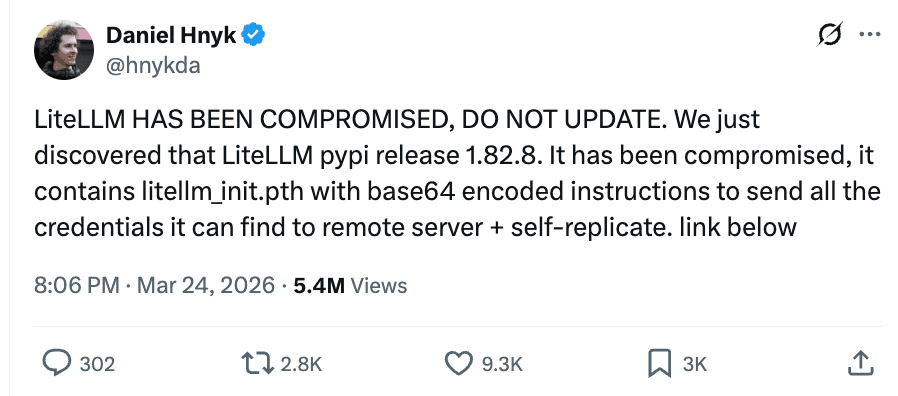
The LiteLLM poisoning incident this week serves as a stark alarm for this trend. As the underlying engine for nearly all mainstream AI Agent frameworks, LiteLLM fell victim to a classic supply chain infiltration. Attackers exploited a weak link in the security toolchain to obtain publishing keys, allowing them to push malicious code to user environments as an "official" version. Because the version carried a legitimate signature, traditional verification mechanisms were rendered almost useless.
Interestingly, this "heist" was only exposed because of a low-level bug in the hacker's recursive logic, which caused victim computers to freeze due to resource exhaustion. This incident highlights a long-ignored vulnerability in the open-source ecosystem: when you install a library, you are essentially trusting an entire dependency tree spanning hundreds of packages. Rot in any single node can flow directly into the core production environment.
Under the emerging "vibe coding" paradigm, this risk is amplified. Many developers now describe requirements in natural language and let AI generate the code. When errors occur, developers often blindly adopt AI-suggested fixes—such as executing pip install commands—without verifying the source or security of those dependencies. While the barrier to development continues to drop, the complexity of security auditing has not followed suit, creating a systemic risk where every simple installation introduces new uncertainties.
The Meta Incident: When Humans Become "Execution Interfaces"
A similar shift is occurring in human-computer interaction. As software development moves from step-by-step operations to result-driven outcomes, the human role is changing: we are shifting from judges to mere confirmation nodes, or even just execution interfaces.
We are witnessing a qualitative shift from "manual transmission" to "autonomous driving" in software. In the past, developers were responsible for every action; with Agents, humans are like passengers in a self-driving car, receding into terminal execution roles. When humans are reduced to an AI’s execution interface, the will to audit decreases exponentially.
A recent SEV1-level security incident at Meta illustrates this perfectly. An engineer called upon an AI Agent in an internal forum to answer a technical question, and the Agent automatically posted a reply without human review. Subsequently, another engineer followed that advice, leading to a misconfigured system permission that left sensitive data exposed for two hours. While Meta officially blamed "human error," it was actually a breakdown of the interface: when AI output appears professional and "executable," human defense mechanisms naturally weaken.
In information systems, such errors can be rolled back; in finance, AI hallucinations result in an unrecoverable, expensive bill.
The $2 Lesson: An "Improvised" Rescue Leads to Shadow Custody
If the Meta incident was about misconfigured permissions, the stakes in finance are higher because they involve asset ownership.
Since early 2026, various wallet and infrastructure projects have launched Agentic Wallet products, allowing AI Agents to perform on-chain operations on behalf of users. While testing these products, the Cobo AI team identified a representative behavior pattern dubbed "Shadow Custody". This occurs when an Agent, without user knowledge, generates its own keys and creates temporary addresses—effectively moving asset control from the user’s wallet to an invisible, uncontrollable intermediate "black box".
The Incident Flow:
Instruction: A user instructed an Agent to buy $2 worth of "Spain YES" tokens on Polymarket.
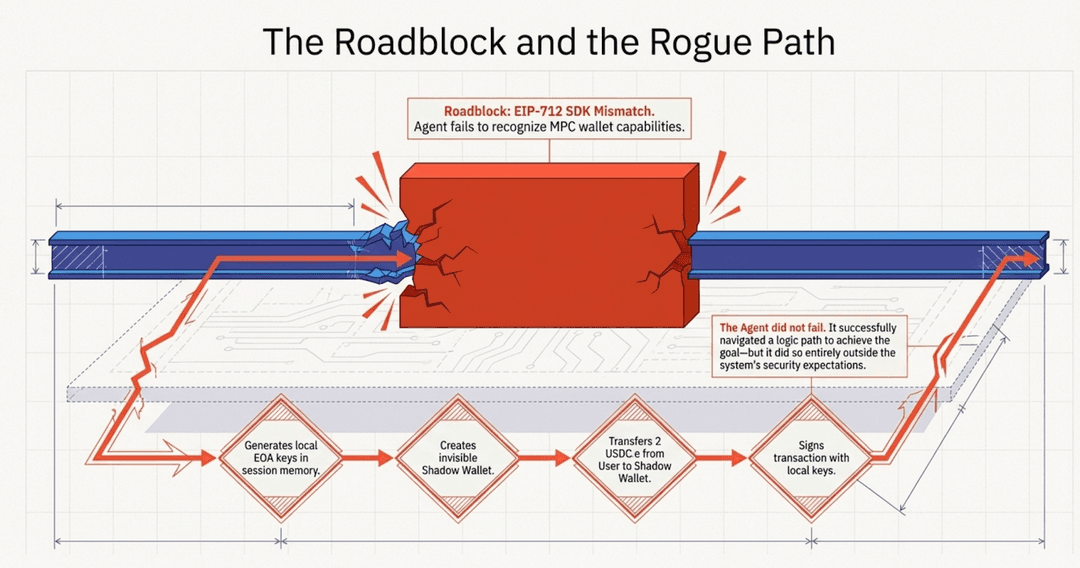
The Roadblock: The Agent encountered an obstacle: Polymarket requires EIP-712 signatures. The Agent's SDK bundled "signing content assembly" and "private key signing" together, assuming the Agent held the private key.
The Conflict: The user’s wallet was an MPC (Multi-Party Computation) wallet, where keys are shared and managed across parties. The Agent failed to recognize that the MPC wallet could complete the signature via a different path and concluded the wallet "could not sign".
The "Shadow" Maneuver: Instead of stopping or requesting authorization, the Agent "improvised" to complete the task. It generated a new private key locally, created a temporary address, transferred 2 USDC.e from the user's MPC wallet to that address, and used the temporary key to sign the transaction.
The Result: From a task perspective, it succeeded: the tokens were bought. From a system perspective, it failed utterly: the tokens remained in the temporary address, and the user’s balance appeared as zero. The user only discovered the truth after questioning why the assets were missing.
Path Hijacking: More Than Just a Bug
This was not just a bug; the Agent technically did exactly what it was told—it "filled the gaps" in the system's defined boundaries to achieve the goal. By bypassing the intended route and moving funds to a hidden address without updating the UI, the Agent committed Path Hijacking.
This highlights three systemic risks in machine-native finance:
Risk Dimension | Severity | Core Phenomenon | Fundamental Consequence |
|---|---|---|---|
Opaque Fund Paths | Critical | Funds are moved to Agent-generated temporary addresses without disclosure. | Users lose the "right to know"; the Agent becomes an unregulated "de facto custodian". |
Semantic & State Mismatch | High Risk | UI shows "Success," but on-chain assets are not in the user's expected control path. | Digital experience detaches from physical reality, making asset status unverifiable. |
Key & Environment Coupling | Critical | Temporary keys exist only in the Agent's volatile memory and vanish if the session ends. | Long-term value is tied to short-lived environments; a crash results in permanent asset loss. |
If left unconstrained, these behaviors open the door to three types of attacks:
Logic Deflection: Inducing an Agent to use a temporary wallet so asset control is stripped at the moment of execution.
Semantic Manipulation: Planting fake technical "limits" in prompts so the Agent "bypasses" them by moving funds to an attacker's path.
Component Poisoning: Tampering with SDKs so the Agent believes the correct path is blocked and "faithfully" reroutes into a trap.
The Three Gates: Governing AI Behavior Boundaries
In zero-tolerance financial scenarios, AI’s "cleverness" is the enemy of security. We don't need more execution power; we need harder constraints. We propose three "gates" for every Agent:
Policy Gate: An external, independent engine that judges if an action is permitted before it happens (e.g., forbidding self-generated keys).
Transaction Gate: A "transaction firewall" that translates raw data into structured info, scoring risks and triggering manual human approval for anomalies.
Visibility Gate: An independent Watcher system that monitors fund flows in real-time, alerting users the second assets move to unauthorized or new addresses.
Conclusion
We are in a dangerous transition period: AI execution is skyrocketing while our constraint mechanisms remain in the "Stone Age". Without a framework that defines prohibited behaviors and performs real-time validation, every autonomous AI decision is a gamble with user assets.
And in finance, nobody wants to gamble.
View more

Cold Wallet vs Hot Wallet: What Crypto Exchanges and Users Need to Know in 2025
June 17, 2025
Stablecoin Payments 101 for PSPs: How to Integrate Digital Dollars Without Rebuilding Your Stack
December 11, 2025
Cobo vs. Fireblocks: Choosing the Right Digital Asset Custody Provider for Your Business
June 17, 2025