
What is Crypto Staking? The Complete 2026 Guide to Earning Passive Income with Digital Assets
January 30, 2026
Cryptocurrency staking has emerged as one of the most popular methods for earning passive income in the digital asset ecosystem. As blockchain networks transition from energy-intensive Proof of Work (PoW) to more efficient Proof of Stake (PoS) consensus mechanisms, staking crypto has become accessible to both individual investors and institutional players. This comprehensive guide explores everything you need to know about crypto staking in 2026, from basic concepts to advanced security considerations, including how to stake crypto for beginners and institutional staking strategies.
What is Crypto Staking?
Staking Definition and Core Concept
Crypto staking is the process of locking up your cryptocurrency holdings to support a blockchain network's operations and security. In return for this commitment, stakers earn rewards, typically in the form of additional cryptocurrency tokens. Think of it as earning interest on a savings account, but instead of a bank using your money for loans, you're helping secure a decentralized network through cryptocurrency staking.
When you stake cryptocurrency, you're essentially becoming a participant in the network's consensus mechanism. Your staked tokens serve as collateral that demonstrates your commitment to validating transactions honestly. The more tokens you stake, the higher your chances of being selected to validate new blocks and earn rewards.
Proof of Stake (PoS) vs Proof of Work (PoW)
To understand staking, it's essential to grasp the difference between Proof of Stake and Proof of Work consensus mechanisms.
According to Ethereum Foundation data, Ethereum's transition to PoS reduced energy consumption by 99.95%, making it one of the most significant sustainability improvements in blockchain history.
Proof of Work (PoW) requires miners to solve complex mathematical puzzles using computational power. Bitcoin operates on PoW, consuming significant energy resources. Miners compete to validate transactions, and the first to solve the puzzle adds the next block to the blockchain.
Proof of Stake (PoS) eliminates the need for energy-intensive mining. Instead, validators are selected based on the amount of cryptocurrency they stake. This approach is more energy-efficient, scalable, and accessible. Ethereum's transition to PoS in 2022 (The Merge) marked a pivotal moment, reducing the network's energy consumption by over 99%.
How Staking Secures Blockchain Networks
Staking creates economic incentives that align validators' interests with network security. Validators who act maliciously or fail to perform their duties risk losing a portion of their staked tokens through a process called "slashing." This penalty mechanism ensures that validators have "skin in the game" and are motivated to maintain network integrity.
The security model is straightforward: attacking a PoS network would require controlling a majority of staked tokens, which becomes prohibitively expensive as the network grows. This economic security makes PoS networks resilient against attacks while consuming a fraction of the energy required by PoW systems.
How Does Crypto Staking Work?
Understanding how staking in crypto works is essential for anyone looking to earn passive income from their digital assets. Whether you're exploring how to stake Ethereum or considering Bitcoin staking options, the process involves several key mechanisms that ensure network security while rewarding participants.
The Validator Selection Process
In Proof of Stake networks, validators are selected to propose and validate new blocks through various mechanisms. Most networks use a combination of factors including:
Stake size: The amount of cryptocurrency locked up
Stake age: How long tokens have been staked
Randomization: To ensure fairness and prevent centralization
For example, Ethereum uses a randomized selection process weighted by stake size. Validators must stake a minimum of 32 ETH to participate directly. Networks like Cardano and Polkadot have different minimum requirements and selection algorithms tailored to their specific architectures.
Block Validation and Consensus
Once selected, validators perform several critical functions:
Propose new blocks: Validators create blocks containing pending transactions
Attest to blocks: Other validators verify the proposed block's validity
Reach consensus: The network agrees on the canonical blockchain state
Finalize blocks: Confirmed blocks become permanent parts of the blockchain
This process happens continuously, with validators rotating through roles to ensure decentralization and security.
Staking Rewards: Where Do They Come From?
Staking rewards originate from three primary sources:
1. Block Rewards (Inflation): New tokens minted by the protocol and distributed to validators. This is similar to how miners receive newly created Bitcoin, but in PoS, it's distributed based on stake rather than computational power.
2. Transaction Fees: Users pay fees to have their transactions included in blocks. Validators who propose blocks collect these fees as part of their rewards.
3. Maximal Extractable Value (MEV): Advanced validators can earn additional income by strategically ordering transactions within blocks. This is more relevant for institutional stakers with sophisticated infrastructure.
The combination of these sources determines your total staking yield, which varies by network, staking method, and market conditions.
Lock-up Periods and Unbonding Explained
Most staking protocols implement lock-up periods to ensure network stability. When you decide to unstake your tokens, you typically enter an "unbonding period" during which:
Your tokens remain locked and don't earn rewards
You cannot transfer or sell your tokens
The duration varies by network (21 days for Cosmos, 28 days for Polkadot, etc.)
Understanding these lock-up periods is crucial for liquidity planning. If you need immediate access to your funds, liquid staking solutions (discussed later) offer alternatives that maintain liquidity while earning staking rewards.
Types of Crypto Staking
Solo Staking (Self-Staking)
Solo staking involves running your own validator node and staking the required minimum directly. This method offers:
Advantages:
Maximum rewards (no intermediary fees)
Full control over your assets
Direct contribution to network decentralization
Disadvantages:
High technical requirements
Significant minimum stake (e.g., 32 ETH for Ethereum)
Responsibility for node uptime and maintenance
Risk of slashing if your node misbehaves
Solo staking is best suited for technically proficient users with substantial capital and the ability to maintain reliable infrastructure.
Delegated Staking (DPoS)
Delegated Proof of Stake allows token holders to delegate their staking power to validators without transferring custody of their assets. You retain ownership while the validator performs the technical work.
How it works:
Choose a reputable validator
Delegate your tokens through your wallet
Earn a share of the validator's rewards (minus their commission)
Maintain custody of your assets
Networks like Cosmos, Tezos, and Polkadot use delegated staking models, making participation accessible to users with smaller holdings.
Pool Staking
Staking pools aggregate tokens from multiple participants to meet minimum staking requirements. This democratizes access to staking for users who don't have enough tokens to stake independently.
Benefits:
Lower entry barriers
Shared rewards proportional to contribution
Professional pool operators handle technical aspects
Considerations:
Pool fees reduce net returns
Trust in pool operator's competence and honesty
Potential smart contract risks
Exchange Staking (Custodial)
Many cryptocurrency exchanges offer staking services where you deposit tokens and the exchange handles everything. This is the most user-friendly option but comes with trade-offs.
Pros:
Extremely simple (often just one click)
No technical knowledge required
Flexible staking and unstaking
No minimum requirements on some platforms
Cons:
You surrender custody of your assets
The digital assets exchange sometimes takes a cut (percentages vary)
Counterparty risk if the digital assets exchange faces issues
Less contribution to network decentralization
Liquid Staking
Liquid staking represents an innovative solution to the liquidity problem inherent in traditional staking. When you stake through liquid staking protocols, you receive derivative tokens representing your staked assets.
How it works:
Stake your tokens (e.g., ETH) with a liquid staking protocol
Receive liquid staking tokens (e.g., stETH) in return
Use these derivative tokens in DeFi while still earning staking rewards
Redeem for your original tokens when desired
Popular liquid staking solutions include Lido, Rocket Pool, and Frax. This approach has grown significantly, with billions of dollars in total value locked. For institutional players, liquid staking infrastructure enables capital efficiency while maintaining staking exposure.
Cold Staking
Cold staking allows you to stake cryptocurrency while keeping your private keys in cold storage (offline wallets). This method prioritizes security by ensuring your keys never touch internet-connected devices.
Security benefits:
Private keys remain in hardware wallets or cold storage
Protection against online attacks and hacks
Suitable for large holdings requiring maximum security
Not all networks support cold staking, but for those that do, it represents the gold standard for secure staking, particularly for institutional investors managing significant assets.
Crypto Staking Rewards and Returns
How Staking Rewards Are Calculated
Staking rewards depend on several variables: network inflation rate, total staked supply, your stake proportion, validator performance, and network fees. The formula varies by network, but generally:
Your Rewards = (Your Stake / Total Staked) × Network Rewards × Validator Performance
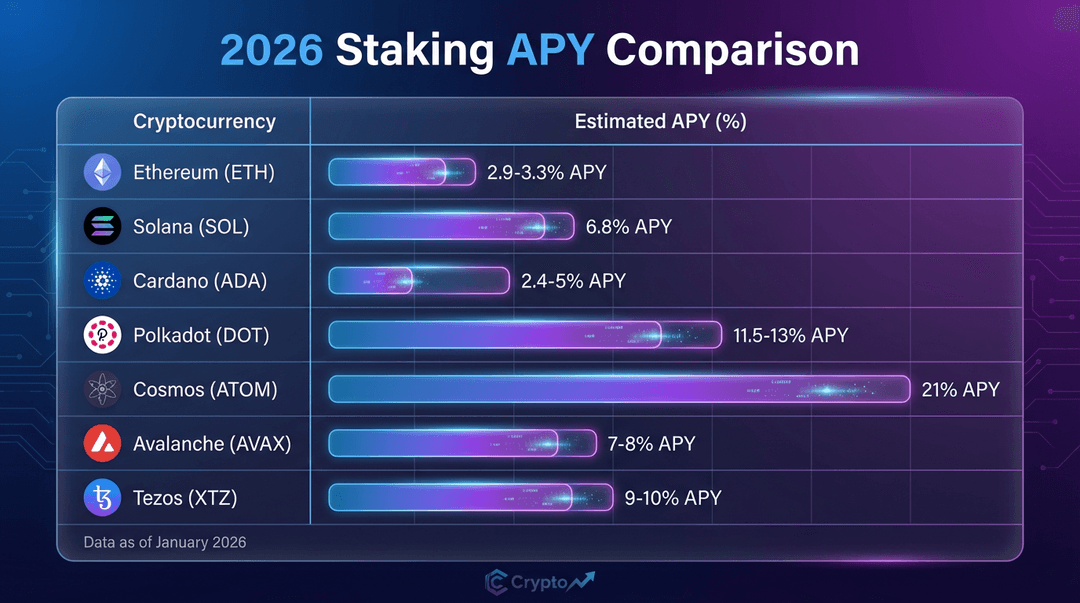
Interactive table comparing staking yields across major cryptocurrencies with real-time data from CoinGecko and Messari.
Data sourced from Datawallet's Ethereum Staking Statistics shows that as of January 2026, 35.86M ETH is staked (28.9% of total supply) with an average 3.3% APY.
Average APY by Cryptocurrency (2026 Data)
Staking yields vary significantly across different cryptocurrencies. Here are approximate annual percentage yields (APY) for major staking assets in 2026:
Ethereum (ETH): 2.9-3.3% APY
Solana (SOL): 6.8% APY
Cardano (ADA): 2.4-5% APY
Polkadot (DOT): 11.5-13% APY
Cosmos (ATOM): 21% APY
Avalanche (AVAX): 7-8% APY
Tezos (XTZ): 9-10% APY
Important note: Higher yields often correlate with higher inflation rates and potentially higher risk. Always consider the total supply dynamics and token economics when evaluating staking opportunities.
Factors Affecting Staking Returns
Several factors influence your actual staking returns:
1. Network participation rate: When fewer tokens are staked, rewards per staker increase. Conversely, high participation dilutes individual returns.
2. Validator commission: Validators charge fees for their services, typically ranging from 3% to 20% of rewards.
3. Slashing events: Penalties for validator misbehavior reduce returns and can impact your principal.
4. Token price volatility: While you earn more tokens, their USD value fluctuates with market conditions.
5. Compounding frequency: How often you claim and restake rewards affects long-term returns.
Compounding Rewards: Maximizing Your Earnings
Compounding significantly amplifies staking returns over time. Instead of withdrawing rewards, restaking them allows you to earn "interest on interest."
Example: Staking 1,000 tokens at 10% APY:
Without compounding: 100 tokens per year = 1,000 tokens after 10 years
With monthly compounding: 1,713 tokens after 10 years (71% more)
Many platforms offer auto-compounding features that automatically restake your rewards. For manual staking, consider the gas fees associated with claiming and restaking as less frequent compounding is sometimes more cost-effective.
Risks of Crypto Staking
Market Volatility Risk
The most significant risk in crypto staking is market volatility. While you earn staking rewards, the underlying token's value can fluctuate dramatically.
Example scenario: You stake 100 tokens worth $5,000 at 10% APY. After one year, you have 110 tokens, but if the token price drops 40%, your holdings are worth only $3,300—a net loss despite earning rewards.
Risk mitigation: Stake assets you believe in long-term, diversify across multiple staking assets, and consider stablecoins or less volatile assets for more predictable returns.
Slashing Penalties Explained
Slashing is a penalty mechanism that reduces a validator's staked tokens for malicious behavior or poor performance. However, slashing events are extremely rare in practice. According to network data, only about 0.04% of Ethereum validators have ever been slashed (472 out of over 1.2 million validators), and slashing appears in approximately 0.0033% of blocks (roughly 1 in 30,000 blocks). Across major PoS networks, less than 0.05% of all staked assets have ever been slashed, with virtually all incidents resulting from technical errors rather than malicious attacks.
Common slashing triggers include:
Double signing: Proposing two different blocks for the same slot
Surround voting: Attesting to blocks that contradict previous attestations
Downtime: Extended periods of validator unavailability
For institutional staking, advanced security infrastructure like MPC (Multi-Party Computation) wallets provides enterprise-grade protection without single points of failure.
Severity varies by network:
Ethereum: Can slash up to 100% of stake for severe violations (though actual slashing is rare)
Cosmos: Typically 5% for double signing, 0.01% for downtime (only 5 slashing events since 2019)
Polkadot: Up to 100% for coordinated attacks (minimal slashing outside early incidents)
Protection strategies: Choose validators with proven track records, diversify across multiple validators, and use professional staking infrastructure with robust monitoring. The rarity of slashing events demonstrates that with proper validator selection and infrastructure, this risk is minimal.
Lock-up Period Liquidity Risk
When your tokens are locked in staking, you cannot access them immediately. This creates several risks:
Opportunity cost: Missing out on better investment opportunities
Market timing: Unable to sell during price peaks or buy dips
Emergency liquidity: Cannot access funds for unexpected needs
Solutions: Maintain a diversified portfolio with liquid assets, use liquid staking derivatives for flexibility, or plan your staking strategy around your liquidity needs.
Validator Performance Risk
For individual users with modest holdings, hardware wallets combined with reputable validators offer solid security. For institutions managing millions or billions in assets, specialized digital asset custody infrastructure is essential.
Miss block proposals, reducing rewards
Experience downtime, triggering penalties
Get slashed, impacting your principal
Charge excessive fees, eroding returns
Due diligence checklist:
Review validator uptime history (aim for >99%)
Check commission rates and fee structures
Assess total stake (avoid over-concentrated validators)
Research team reputation and infrastructure
Monitor performance regularly
Platform and Counterparty Risk
When using custodial staking services (exchanges, platforms), you face counterparty risk:
Exchange insolvency: Platform bankruptcy could result in loss of funds
Hacks and security breaches: Centralized platforms are attractive targets
Regulatory actions: Platforms may freeze withdrawals or face shutdowns
Terms changes: Platforms can modify fees or conditions
The collapse of several major exchanges in recent years underscores this risk. For significant holdings, non-custodial solutions or institutional-grade custody infrastructure provide better security.
Smart Contract Vulnerabilities
Liquid staking and DeFi staking protocols rely on smart contracts, which can contain bugs or vulnerabilities:
Code exploits: Hackers may discover and exploit contract weaknesses
Economic attacks: Flash loan attacks or other DeFi-specific risks
Upgrade risks: Protocol changes may introduce new vulnerabilities
Risk reduction: Use audited protocols with proven track records, diversify across multiple platforms, and stay informed about security incidents in the ecosystem.
Best Cryptocurrencies for Staking in 2026
Ethereum (ETH) Staking
Ethereum remains the largest and most significant PoS network after its successful transition from Proof of Work.
Key details:
Minimum stake: 32 ETH for solo staking
APY: 3-4%
Lock-up: Withdrawals enabled since Shanghai upgrade
Slashing risk: Moderate
Why stake ETH: As the foundation of the DeFi ecosystem, Ethereum offers stability and long-term viability.
Solana (SOL) Staking
Key details: No minimum for delegated staking | 6-7% APY | 2-3 day lock-up | Low slashing risk
Why stake SOL: Higher yields, growing ecosystem, and strong institutional backing.
Cardano (ADA) Staking
Key details: No minimum | 4-5% APY | No lock-up | No slashing risk
Why stake ADA: Most user-friendly staking experience with no lock-up periods or slashing, ideal for beginners.
Polkadot (DOT) Staking
Key details: ~250 DOT minimum | 10-14% APY | 28-day unbonding | Moderate slashing risk
For serious stakers, hybrid approaches combining self-custody with professional staking services offer optimal security and convenience.
Cosmos (ATOM) Staking
Key details: No minimum | 12-18% APY | 21-day unbonding | Moderate slashing risk
Why stake ATOM: Attractive yields and growing ecosystem, though higher inflation rates should be considered.
How to Choose a Crypto Staking Platform
Custodial vs Non-Custodial Platforms
The fundamental choice in staking is whether to maintain custody of your assets or entrust them to a third party.
Custodial platforms (exchanges like Coinbase, Binance, Kraken):
Pros: Simple, user-friendly, no technical knowledge required
Cons: Counterparty risk, lower returns due to fees, less control
Non-custodial platforms (wallets, validators, protocols):
Pros: You control your keys, higher returns, contribute to decentralization
Cons: Technical complexity, responsibility for security, higher minimum stakes
For institutional investors, specialized custody solutions that combine security with staking capabilities offer the best of both worlds.
Key Factors to Consider
When evaluating staking platforms, assess:
1. Security track record: Has the platform experienced hacks or security incidents?
2. Reputation and longevity: How long has the platform operated successfully?
3. Supported assets: Does it support the cryptocurrencies you want to stake?
4. Fee structure: What percentage of rewards does the platform take?
5. Minimum requirements: Can you meet the minimum staking amounts?
6. Liquidity options: How quickly can you unstake and access funds?
7. User experience: Is the interface intuitive and well-documented?
8. Customer support: Can you get help when needed?
Security Features to Look For
Security should be your top priority when choosing a staking platform:
Essential security features:
Multi-signature wallets: Requiring multiple approvals for transactions
Cold storage: Keeping the majority of assets offline
Insurance coverage: Protection against certain types of losses
Regular security audits: Third-party verification of security practices
Two-factor authentication: Additional account protection
Withdrawal whitelisting: Restricting withdrawals to pre-approved addresses
For institutional staking, advanced security infrastructure like MPC (Multi-Party Computation) wallets provides enterprise-grade protection without single points of failure.
Fee Structures and Hidden Costs
Understanding the complete fee structure is crucial for calculating actual returns:
Common fees:
Platform fees: Percentage of staking rewards (typically 10-35% for exchanges)
Validator commission: Fees charged by validators (3-20%)
Network fees: Gas costs for staking and unstaking transactions
Withdrawal fees: Costs to move assets off the platform
Performance fees: Additional charges on profits
Example calculation: 10% APY with 25% platform fee and 5% validator commission = 7% actual APY (10% × 0.75 × 0.95)
Always calculate your net returns after all fees to make informed comparisons.
Staking Security: Protecting Your Assets
The Importance of Custody Solutions
As staking has grown into a multi-billion dollar industry, custody solutions have become critical for protecting staked assets. The choice of custody method directly impacts security, accessibility, and operational efficiency.
Custody considerations for staking:
Key management: How are private keys generated, stored, and used?
Access controls: Who can initiate staking and unstaking operations?
Disaster recovery: What happens if keys are lost or compromised?
Operational security: How are staking operations executed securely?
For individual users with modest holdings, hardware wallets combined with reputable validators offer solid security. For institutions managing millions or billions in assets, specialized infrastructure is essential.
MPC Wallets for Institutional Staking
Multi-Party Computation (MPC) wallets represent the cutting edge of secure staking infrastructure. Unlike traditional wallets where a single private key controls assets, MPC distributes cryptographic key shares across multiple parties.
How MPC enhances staking security:
No single point of failure: No individual holds the complete private key
Flexible access policies: Require multiple approvals for transactions
Operational continuity: Key shares can be recovered if one party is compromised
Regulatory compliance: Separation of duties meets institutional requirements
MPC technology enables institutions to stake large amounts securely while maintaining operational flexibility. This infrastructure supports both hot staking (for active validation) and cold staking (for maximum security).
Self-Custody vs Custodial Staking
The self-custody versus custodial decision involves trade-offs between security, convenience, and control.
Self-custody staking:
Full control: You own your keys and assets
Maximum security: No counterparty risk
Higher complexity: Requires technical knowledge
Greater responsibility: You're responsible for security and operations
Custodial staking:
Convenience: Platform handles everything
Lower barriers: No technical expertise needed
Counterparty risk: Trust in the platform's security and solvency
Regulatory clarity: Platforms may offer compliance support
For serious stakers, hybrid approaches combining self-custody with professional staking services offer optimal security and convenience.
Best Practices for Secure Staking
Implement these security best practices to protect your staked assets:
1. Use hardware wallets: Keep private keys in cold storage when possible
2. Enable all security features: 2FA, withdrawal whitelisting, email confirmations
3. Diversify validators: Don't stake everything with a single validator
4. Regular monitoring: Check validator performance and rewards frequently
5. Keep software updated: Ensure wallets and nodes run the latest secure versions
6. Backup everything: Maintain secure backups of seed phrases and configurations
7. Test with small amounts: Verify processes work before committing large sums
8. Stay informed: Follow network updates and security announcements
9. Use reputable services: Stick with established, audited platforms and validators
10. Consider insurance: For large holdings, explore custody insurance options
How to Start Staking Crypto: Step-by-Step Guide
Step 1: Choose Your Cryptocurrency
Select a staking asset based on your goals, risk tolerance, and investment timeline:
Considerations:
Yield requirements: What APY do you need to meet your goals?
Risk tolerance: Can you handle high volatility for higher returns?
Lock-up periods: How long can you commit your capital?
Minimum stakes: Do you have enough to meet requirements?
Network fundamentals: Do you believe in the project's long-term viability?
Research the tokenomics, inflation rates, and staking mechanics of your chosen cryptocurrency before committing funds.
Step 2: Select a Staking Method
Based on your technical skills, capital, and preferences, choose your staking approach:
For beginners: Exchange staking or delegated staking For intermediate users: Staking pools or liquid staking protocols For advanced users: Solo staking with your own validator For institutions: Professional custody solutions with staking capabilities
Step 3: Set Up Your Wallet
Depending on your chosen method, you'll need the appropriate wallet:
For exchange staking: Create an account on a reputable exchange For delegated staking: Use a compatible wallet (e.g., Keplr for Cosmos, Polkadot.js for Polkadot) For solo staking: Set up a validator node and secure wallet infrastructure For liquid staking: Connect a Web3 wallet like MetaMask to the protocol
Security setup:
Enable two-factor authentication
Securely backup your seed phrase (never store digitally)
Test wallet functionality with small amounts first
Verify you're using official wallet software
Step 4: Acquire and Stake Your Tokens
Purchase your chosen cryptocurrency and initiate staking:
Acquisition:
Buy from reputable exchanges
Transfer to your staking wallet (if not staking on exchange)
Verify transaction confirmations before proceeding
Staking process:
Exchange staking: Navigate to staking section, select asset, choose amount, confirm
Delegated staking: Choose validator, delegate tokens through wallet interface
Pool staking: Connect wallet to pool, deposit tokens, receive pool tokens
Liquid staking: Deposit tokens to protocol, receive liquid staking derivatives
Step 5: Monitor and Claim Rewards
After staking, maintain active oversight of your investment:
Monitoring:
Check validator performance regularly
Track reward accumulation
Monitor network updates and changes
Watch for slashing events or issues
Popular liquid staking solutions include Lido, Rocket Pool, and Frax. This approach has grown significantly, with over $25 billion in total value locked across liquid staking protocols as of 2026. The liquid staking market has expanded from $168 million in 2024 to nearly $200 million in 2025, demonstrating strong institutional and retail adoption. For institutional players, liquid staking infrastructure enables capital efficiency while maintaining staking exposure.
Institutional Crypto Staking
Enterprise-Grade Staking Infrastructure
Institutional staking requires infrastructure that meets enterprise security, compliance, and operational standards:
Key requirements:
Institutional custody: Secure key management with proper controls
High availability: Redundant infrastructure ensuring maximum uptime
Scalability: Ability to stake across multiple networks and validators
Reporting: Comprehensive analytics and performance tracking
Integration: APIs for connecting to existing systems
Support: Dedicated technical and customer support
Modern staking infrastructure leverages technologies like MPC wallets, hardware security modules (HSMs), and distributed validator technology (DVT) to meet these requirements.
Compliance and Regulatory Considerations
Institutional stakers must navigate complex regulatory landscapes:
Regulatory concerns:
Securities classification: Are staking rewards considered securities?
Tax treatment: How are staking rewards taxed in different jurisdictions?
Custody regulations: What custody standards apply to staked assets?
Reporting requirements: What disclosures are required for stakeholders?
AML/KYC: How do compliance requirements affect staking operations?
Working with platforms that understand institutional compliance needs and provide appropriate documentation and controls is essential for regulated entities.
Scaling Staking Operations Securely
As institutions scale their staking operations, they face unique challenges:
Scaling considerations:
Multi-network staking: Managing stakes across different blockchains
Validator diversification: Spreading risk across multiple validators
Operational efficiency: Automating routine tasks while maintaining security
Risk management: Monitoring and mitigating various staking risks
How to Start Staking with Cobo's Institutional Staking App
For institutions seeking enterprise-grade staking infrastructure, Cobo's Staking App in the Cobo Portal offers a comprehensive solution designed specifically for organizational needs. The platform enables institutions to earn yield securely on assets like BTC and ETH while maintaining full control through non-custodial MPC wallets.
Why Choose Cobo for Institutional Staking
Uncompromised Security & Control: Institutions stake directly from their own organization-controlled MPC Wallets. This non-custodial approach means they maintain full control of their assets at all times, eliminating third-party counterparty risk.
Enterprise-Grade Reliability: The platform integrates with vetted, top-tier node providers like stakefish and Figment. This ensures high uptime and performance, mitigating slashing risks and optimizing your net yield.
Streamlined Governance & Compliance: The app features role-based access controls, allowing for proper segregation of duties within your team. All staking activities are logged for a clear audit trail, simplifying reporting and compliance.
Scalable Integration: A comprehensive Staking API is available, enabling enterprises to programmatically manage and scale their staking operations without sacrificing security or control.
Transparent Fee Structure: Cobo's competitive fee model ensures you maximize your staking returns:
BTC Staking (Babylon Protocol): When Cobo acts as the Finality Provider, a 5% commission is applied to staking rewards only—your principal remains untouched.
ETH Staking (Beacon Chain): Fees apply only to Execution Layer rewards (MEV, tips, and transaction fees). Consensus Layer rewards from block production are distributed directly to your withdrawal address with zero fees to Cobo or node providers. Fee structures may vary depending on your chosen node provider (stakefish or Figment).
Step 1: Choose a Staking Asset
Log in to Cobo Portal and open the Staking App. Review supported assets (e.g., BTC via Babylon Protocol, ETH via Beacon Chain). Check the estimated APR, available balance, and reward history from the institutional dashboard, then select the asset you wish to stake.
Tip: Cobo Portal offers institutional-grade Ethereum staking (ETH) with trusted providers, ensuring enterprise-grade reliability for ETH staking activities.
Step 2: Initiate Staking via the Cobo Portal
From the dashboard, click "Stake" under the desired asset. Complete the required fields: Select PoS Chain (e.g., Babylon or Beacon Chain), choose from the list of vetted Node Providers, specify staking amount and duration, and select network fee speed. Review all details and confirm.
The system performs automated risk control and balance verification to ensure policy compliance before submission. Your status updates to "Active" in your dashboard upon success.
Step 3: Monitor and Manage Staking Rewards
Access "Assets Overview" to monitor your portfolio's performance, including total staked amount, estimated APR, and unclaimed rewards. Use the "Activity" log to track and export a complete history of all staking, unstaking, and withdrawal events for auditing and reporting.
Understanding ETH Reward Distribution: For Ethereum staking, rewards are split into two categories:
Consensus Layer Rewards: Generated from block production and attestation duties. These rewards are distributed directly to your designated withdrawal address with no fees deducted by Cobo or node providers.
Execution Layer Rewards: Include MEV (Maximal Extractable Value), priority fees, and transaction tips. These rewards are subject to fee sharing with your chosen node provider, with specific rates varying by provider.
For BTC staking via Babylon, rewards accumulate based on your staking duration and the protocol's reward distribution schedule. All reward calculations are transparent and viewable in real-time through your Cobo Portal dashboard.
Start Staking Crypto with Cobo Portal
Now that you understand how staking works for institutional portfolios, it's time to put assets to work. Cobo's Staking App offers trusted yield generation, allowing you to earn on assets like BTC and ETH while maintaining full control through MPC Wallets.
Ready to enhance your digital asset strategy?
Explore the Staking App in Cobo Portal to see how our platform can optimize your yield generation securely. Contact Cobo today to schedule a demo and learn how to integrate institutional-grade staking into your operations.
Performance optimization: Maximizing returns while controlling costs
Professional staking infrastructure enables institutions to scale efficiently while maintaining the security and controls required for large asset pools.
Staking vs Other Crypto Earning Methods
Staking vs Mining
Staking:
Low energy consumption
Lower capital requirements (no specialized hardware)
Passive income with minimal ongoing effort
Accessible to average users
Returns based on stake size
Mining:
High energy consumption
Significant upfront investment in hardware
Ongoing operational costs (electricity, cooling, maintenance)
Increasingly centralized due to economies of scale
Returns based on computational power
Verdict: For most users, staking offers a more accessible and sustainable way to earn crypto rewards.
Staking vs Yield Farming
Staking:
Lower risk (protocol-level rewards)
More predictable returns
Simpler to understand and execute
Lower potential returns
Longer-term commitment
Yield Farming:
Higher risk (smart contract vulnerabilities, impermanent loss)
Potentially higher returns
More complex strategies
Requires active management
More flexible (can exit quickly)
Verdict: Staking suits conservative investors seeking steady returns, while yield farming appeals to those willing to accept higher risk for potentially greater rewards.
Staking vs Lending
Staking:
Rewards from network inflation and fees
Contributes to network security
Lock-up periods vary by network
No counterparty risk (in non-custodial staking)
Returns tied to network economics
Lending:
Interest from borrowers
Provides liquidity to markets
Often more flexible terms
Counterparty risk (borrower default)
Returns tied to supply/demand dynamics
Verdict: Both can complement each other in a diversified crypto income strategy.
Tax Implications of Crypto Staking
How Staking Rewards Are Taxed
Tax treatment of staking rewards varies by jurisdiction, but common approaches include:
United States:
Staking rewards are generally taxed as ordinary income when received
Fair market value at receipt determines taxable amount
Subsequent sale may trigger capital gains/losses
Some argue rewards shouldn't be taxed until sold (ongoing legal debate)
European Union:
Treatment varies by member state
Some countries tax at receipt, others at disposal
Rates and rules differ significantly across jurisdictions
Other jurisdictions:
Some countries offer tax-free crypto gains (e.g., Portugal, Germany after 1 year)
Others have specific crypto tax regimes
Regulations continue evolving globally
Important: Consult with a tax professional familiar with crypto taxation in your jurisdiction.
Record Keeping for Staking Income
Proper record-keeping is essential for tax compliance:
What to track:
Date and time of each reward receipt
Amount of cryptocurrency received
Fair market value in your local currency at receipt
Transaction IDs and blockchain records
Staking platform and validator information
Fees paid for staking services
Dates and amounts of unstaking events
Tools and methods:
Crypto tax software (CoinTracker, Koinly, CryptoTaxCalculator)
Spreadsheet tracking
Platform export features
Blockchain explorers for verification
Maintaining detailed records from the start prevents headaches during tax season and provides documentation if audited.
The Future of Crypto Staking in 2026 and Beyond
Emerging Trends in Staking
The staking landscape continues evolving rapidly:
1. Distributed Validator Technology (DVT): Spreading validator duties across multiple nodes to improve resilience and decentralization
2. Restaking protocols: Allowing staked assets to secure multiple networks simultaneously, increasing capital efficiency
3. Cross-chain staking: Staking assets on one chain to secure another, enabled by interoperability protocols
4. Governance integration: Staking increasingly tied to governance rights, giving stakers more influence over protocol development
5. Institutional products: Specialized staking products designed for institutional investors, including derivatives and structured products
Liquid Staking Derivatives Growth
Liquid staking has experienced explosive growth and shows no signs of slowing:
Market dynamics:
Billions in total value locked across liquid staking protocols
Integration with DeFi creating new use cases
Competition driving innovation and better yields
Regulatory scrutiny increasing as market grows
Future developments:
More sophisticated liquid staking derivatives
Better integration with traditional finance
Improved security through audits and insurance
Expansion to more blockchain networks
Liquid staking solves the fundamental trade-off between earning staking rewards and maintaining liquidity, making it increasingly attractive to both retail and institutional participants.
Institutional Adoption Drivers
Several factors are accelerating institutional adoption of staking:
1. Regulatory clarity: Clearer rules around staking and custody
2. Infrastructure maturity: Enterprise-grade solutions now available
3. Yield in low-rate environment: Attractive returns compared to traditional fixed income
4. ESG considerations: PoS's energy efficiency appeals to ESG-focused investors
5. Portfolio diversification: Uncorrelated returns enhance portfolio construction
6. Client demand: Institutional clients seeking crypto exposure and yield
As traditional financial institutions increasingly offer crypto services, staking will become a standard component of institutional digital asset strategies.
Frequently Asked Questions (FAQ)
Is crypto staking safe?
Crypto staking involves several risks including market volatility, slashing penalties, platform risks, and smart contract vulnerabilities. However, when done properly with reputable platforms and validators, staking can be relatively safe. The key is understanding the risks, choosing secure infrastructure, and not staking more than you can afford to lose. Non-custodial staking with proven validators generally offers better security than custodial exchange staking.
Can you lose money staking crypto?
Yes, you can lose money staking crypto in several ways: (1) The token price can decline, offsetting staking rewards; (2) Slashing penalties can reduce your principal if your validator misbehaves; (3) Platform failures or hacks can result in loss of custodial assets; (4) Smart contract bugs in liquid staking protocols can be exploited. However, if you choose reputable validators and platforms, the primary risk is market volatility rather than loss of tokens.
What is the minimum amount needed to stake?
Minimum staking amounts vary widely by cryptocurrency and method. Solo staking Ethereum requires 32 ETH (approximately $100,000+ at current prices), while delegated staking on networks like Cosmos, Cardano, or Solana has no minimum. Exchange staking often allows you to stake any amount. Staking pools typically have low minimums, making staking accessible even with small holdings.
How long does it take to unstake crypto?
Unstaking periods (unbonding periods) vary by network: Ethereum has no fixed unbonding period but may have withdrawal queues; Cosmos requires 21 days; Polkadot requires 28 days; Solana requires 2-3 days; Cardano has no unbonding period. During unbonding, your tokens don't earn rewards and cannot be transferred. Liquid staking solutions can provide immediate liquidity by allowing you to trade your staking derivatives.
Is staking better than holding?
Staking is generally better than simply holding if you believe in the asset long-term and don't need immediate liquidity. Staking generates passive income (typically 3-18% APY depending on the asset) while holding generates no returns. However, staking involves additional risks like slashing, lock-up periods, and platform risks. If you need flexibility to sell quickly or are uncertain about the asset's future, holding might be preferable. For long-term believers, staking maximizes returns on assets you'd hold anyway.
Conclusion: Is Crypto Staking Right for You?
Crypto staking offers an attractive opportunity to earn passive income on digital assets you believe in long-term. With yields ranging from 3% to 18% APY across major cryptocurrencies, staking can significantly enhance returns compared to simply holding assets.
Staking is ideal for you if:
You have a long-term investment horizon
You believe in the fundamental value of PoS cryptocurrencies
You're comfortable with the technical aspects or willing to use user-friendly platforms
You can tolerate market volatility
You don't need immediate access to your capital
Consider alternatives if:
You need high liquidity and quick access to funds
You're uncomfortable with the technical complexity
You're seeking guaranteed returns (staking rewards fluctuate)
You're unwilling to accept the various risks involved
For those ready to start staking, begin with small amounts on user-friendly platforms to learn the process. As you gain confidence and understanding, you can scale up your staking operations and explore more advanced strategies.
The key to successful staking is education, proper risk management, and choosing secure infrastructure that matches your needs. Whether you're an individual investor seeking passive income or an institution building a comprehensive digital asset strategy, staking represents a fundamental component of the evolving crypto ecosystem.
For institutional investors requiring enterprise-grade security and infrastructure, solutions combining advanced custody technology with professional staking services provide the optimal balance of security, returns, and operational efficiency. As the staking landscape continues maturing, those who understand and implement best practices will be well-positioned to benefit from this growing opportunity.
View more

Cold Wallet vs Hot Wallet: What Crypto Exchanges and Users Need to Know in 2025
June 17, 2025
Stablecoin Payments 101 for PSPs: How to Integrate Digital Dollars Without Rebuilding Your Stack
December 11, 2025

Cobo vs. Fireblocks: Choosing the Right Digital Asset Custody Provider for Your Business
June 17, 2025